
How Thoughtful Classroom Design Supports Learning
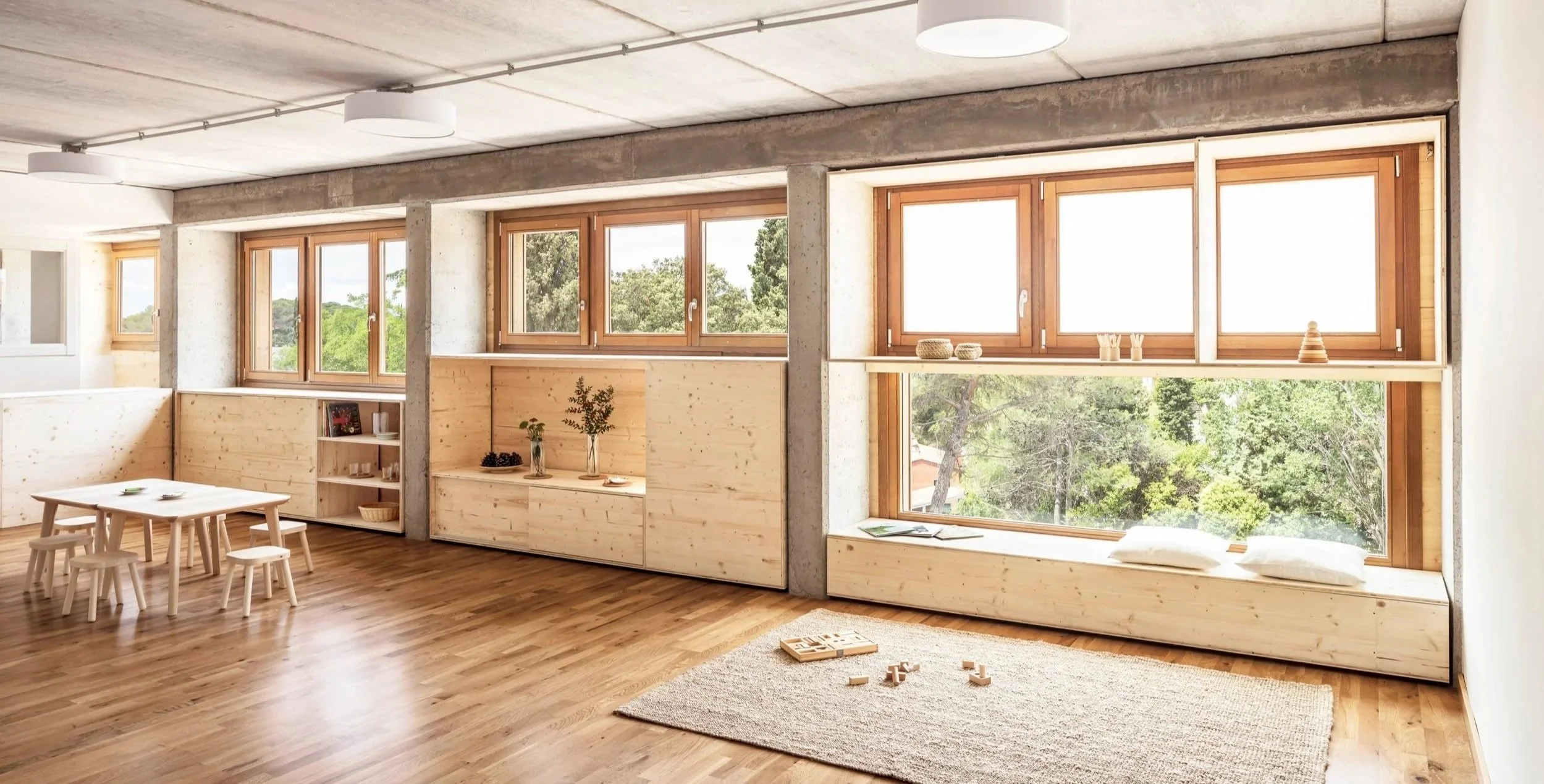
Architects: Eduard Balcells, Ignasi Rius Architecture, Tigges Architekt / Photographs: Adrià Goula Photo
Children do not experience learning in isolation from their environment. In a classroom, space is never neutral — it actively influences how children move, concentrate, relate to others, and develop autonomy.
In educational space design, the classroom becomes part of the learning process itself, acting as a third educator rather than simply a space for learning.
The classroom as a developmental environment
In early childhood and primary education, the classroom influences:
Autonomy in daily actions
Concentration and sustained attention
Movement and physical engagement
Collaboration and social interaction
Emotional regulation through structure and clarity
When the environment is intentionally designed, it supports these processes rather than interrupting them.
A well-designed classroom creates clarity. Children understand where things belong, how to navigate the space, and how to engage with materials without constant adult intervention. This sense of order is not restrictive — it is what makes freedom possible within the environment.
What makes a classroom intentional?
An intentional educational space is not defined by decoration or style, but by how it supports the child’s experience within it.
Key principles include:
Accessibility: materials are visible and within reach
Order: clear spatial structure supports orientation
Movement: space allows different forms of engagement
Simplicity: reduced visual noise supports focus
Purpose: every element has an educational role
These principles appear across Montessori-inspired, Reggio Emilia, and other pedagogical approaches. At their core, they reflect a shared understanding: the environment is an active part of learning.
Leading architects and educational designers have long emphasized this relationship between space and development. Designers such as Herman Hertzberger and Rosan Bosch demonstrate how environments can encourage autonomy, collaboration, and creativity when designed with intention.
Their work reinforces a key idea: classrooms are not passive spaces. They are active participants in children’s learning experiences.
Why pedagogy and design must work together
Space design becomes meaningful when it is guided by educational intention. Without this connection, environments risk becoming either purely aesthetic or purely functional.
When pedagogy and design align, the space supports learning, autonomy, and development in a more integrated way.
This perspective is increasingly adopted by educators, architects, and design studios who understand that learning environments directly influence childhood development.
How this connects to Sínia Spaces
At Sínia Spaces, we design learning environments where pedagogy and space are developed together.
This approach informs all our work:
Sínia Design (classrooms, schools, and learning environments)
Sínia Courses (guidance for families and educators)
Sínia Play (outdoor and experiential learning environments)